HMO compliance

HMO fire risk assessment in Bexley

Find out what a specialist checks during an HMO fire risk assessment, from door sets and alarm grades to escape routes from upper storeys. Learn how the resulting report satisfies licensing conditions set by Bexley Council.

HMO licence requirements

People crossing a pedestrian lane during daytime.
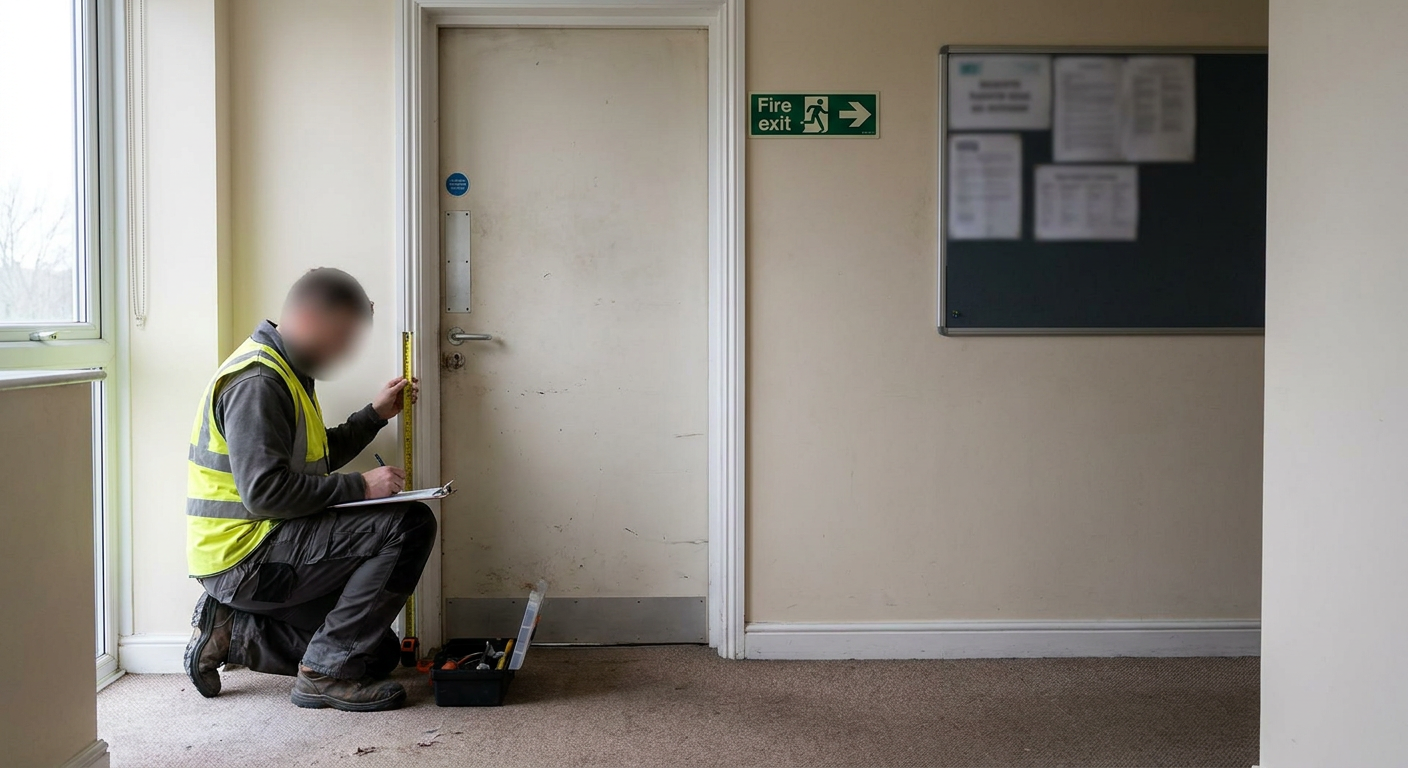
Worker in hi-vis kneeling to measure a fire door frame with a tape measure.

When Bexley Council asks for a shared house fire safety check

A letter from Bexley Council asking for an HMO fire risk assessment means the licensing team needs proof that the building is safe for multiple households. The request usually arrives with a deadline. An assessor visits the home to examine how fire starts, how it spreads and how people get out.

During a shared house fire safety check, the specialist examines every part of the building that affects escape. They look at the layout, the materials used in walls and ceilings, and the condition of doors separating rooms from hallways. Electrical installations, portable heaters and cooking facilities all come under scrutiny because they are common ignition sources in shared homes.

The result is a landlord fire risk report that records what was found and ranks each hazard by urgency. Bexley Council expects this document to follow a recognised format so their officers can verify compliance without needing to visit the home themselves. Letting agents arranging a fire assessment for letting agent purposes receive the same detailed record, since the legal duty falls on whoever controls the premises. Read more about [what happens during the visit](/the-assessor/the-process-bexley).

Alarm grades and detection in a bedsit or shared house

The grade of alarm system a shared house needs depends on its size, layout and the number of occupants. A small HMO with two storeys and up to four tenants often requires a Grade D1 system: mains-powered alarms with battery backup, interlinked so that a detector in the kitchen triggers the sounder in a top-floor bedroom.

Larger homes, or those where individual bedsits have their own locks, typically need a Grade A panel system. This uses separate zones, allowing the fire service to identify exactly which room triggered the alert. A bedsit fire alarm grade must account for the fact that tenants sleep behind closed doors and might not hear a standalone smoke alarm in the hallway.

The assessor checks whether detectors sit in the right places. Kitchens need heat detectors to avoid false alarms from cooking; hallways, landings and living rooms need optical smoke detectors. They also verify that the control panel has a key switch, that batteries are within date and that test buttons work. Guidance on [HMO licence fire safety requirements](/compliance/hmo-licence-fire-safety-requirements) explains the categories Bexley Council applies.

Bedroom doors, closers and compartmentation

Bedroom doors in a shared house generally need to be fire doors fitted with self-closing devices. The purpose is to hold back smoke and flame long enough for occupants to reach the stairs. A standard internal door with hollow panels offers almost no resistance to fire, so the assessor checks thickness, material and certification marks on the edge or top. Closers must shut the door fully into the frame every time. If a tenant wedges a door open, the closer defeats its own purpose, but the hardware itself must be capable of doing the job. Intumescent strips and cold smoke seals around the frame expand when heated, blocking gaps that would otherwise let toxic gas through. The specialist inspects hinges, locks and letterboxes too. Thumb-turn locks on the inside allow escape without a key, while external access lets the responsible person enter in an emergency. Where doors fail these checks, the report specifies replacements. A [fire door inspection](/fire-door-inspection) covers these points in detail for homes in Bexley.

Escaping from the top floor of a converted terrace

Converted terraces in Bexley present particular problems for escape. Staircases are often narrow, winding and built before modern fire regulations existed. The assessor evaluates whether everyone sleeping on the upper storeys can reach a final exit without passing through a high-risk room such as a kitchen.

Where the travel distance is too long, or the stairwell lacks protection, secondary escape routes become necessary. This might mean an external metal staircase fixed to the rear wall, or a window large enough for a person to climb through onto a flat roof that leads to a neighbouring building. Escape windows must open without tools and have a low enough sill height.

The specialist also looks at what lines the escape route. Plasterboard on the stairwell walls and ceiling should offer thirty minutes of fire resistance. If lath and plaster remains from the original conversion, its condition matters because cracked sections lose integrity quickly under heat. Compartmentation surveys examine these hidden barriers. Find out more about [compartmentation in Bexley homes](/compartmentation-survey).

Access to rooms and tenant cooperation

An HMO fire risk assessment cannot be completed if the assessor is locked out of bedrooms. Every room forms part of the escape route or acts as a potential fire source, so the specialist needs to see inside each one. Tenants must give access on the agreed date.

Landlords and agents should notify occupants well ahead of the visit. A written notice explaining why the inspection is happening, who will attend and how long it takes prevents confusion. The assessor does not search personal belongings, but they do check behind furniture for blocked sockets, overloaded extension leads and portable heaters placed near curtains.

If a tenant refuses entry, the report notes the limitation. Bexley Council may treat an incomplete assessment as non-compliance, which delays the licence application. In practice, most tenants cooperate once they understand the visit protects them. Arranging the appointment through the [responsible person](/compliance/who-is-the-responsible-person) ensures clear communication between landlord, agent and occupier.

Meeting the licensing condition in your council letter

The letter from Bexley Council names a specific condition: provide a suitable and sufficient fire risk assessment. The report produced by the specialist addresses this directly. It documents hazards, identifies who is at risk, evaluates existing precautions and records actions needed to reduce danger to an acceptable level.

Council officers look for certain elements. They want to see that the assessor examined the building in person rather than relying on plans alone. They check that recommendations carry realistic timescales and that immediate dangers are flagged for action before anyone sleeps in the home again. A generic template downloaded from the internet rarely satisfies these expectations.

Once submitted, the licensing team reviews the findings alongside other HMO licence fire requirements. If the report recommends changes, the council may attach those changes as further conditions. Keeping a copy of the assessment and any receipts for completed work demonstrates ongoing compliance. Guidance on [responding to a council fire safety letter](/compliance/council-fire-safety-letter-what-to-do) outlines the steps to follow.

What happens when work cannot be done straight away

The assessment report separates urgent risks from longer-term improvements. If something poses an immediate threat to life, such as a missing fire door on a kitchen opening directly onto the only staircase, the specialist marks it for action before the home is occupied again. Bexley Council expects these items resolved without delay.

Other recommendations might involve upgrading an alarm panel or replacing single-glazed fanlights above doors. These take time to specify, price and schedule. The report assigns a priority and a suggested timeframe. Landlords use this schedule to plan contractors and budget accordingly.

Documenting the plan matters. If a fire occurs while work is pending, showing that a competent person identified the hazard, ranked it lower than immediate threats and scheduled remediation demonstrates responsible management. The [nominated person service](/nominated-person-service) helps landlords in Bexley maintain oversight when multiple properties require staged upgrades. Keeping the log book updated with progress notes supports future reviews.

Choosing the right assessment scope

HMOs vary in size and layout across Bexley, so the depth of inspection differs depending on the building type and licence category.
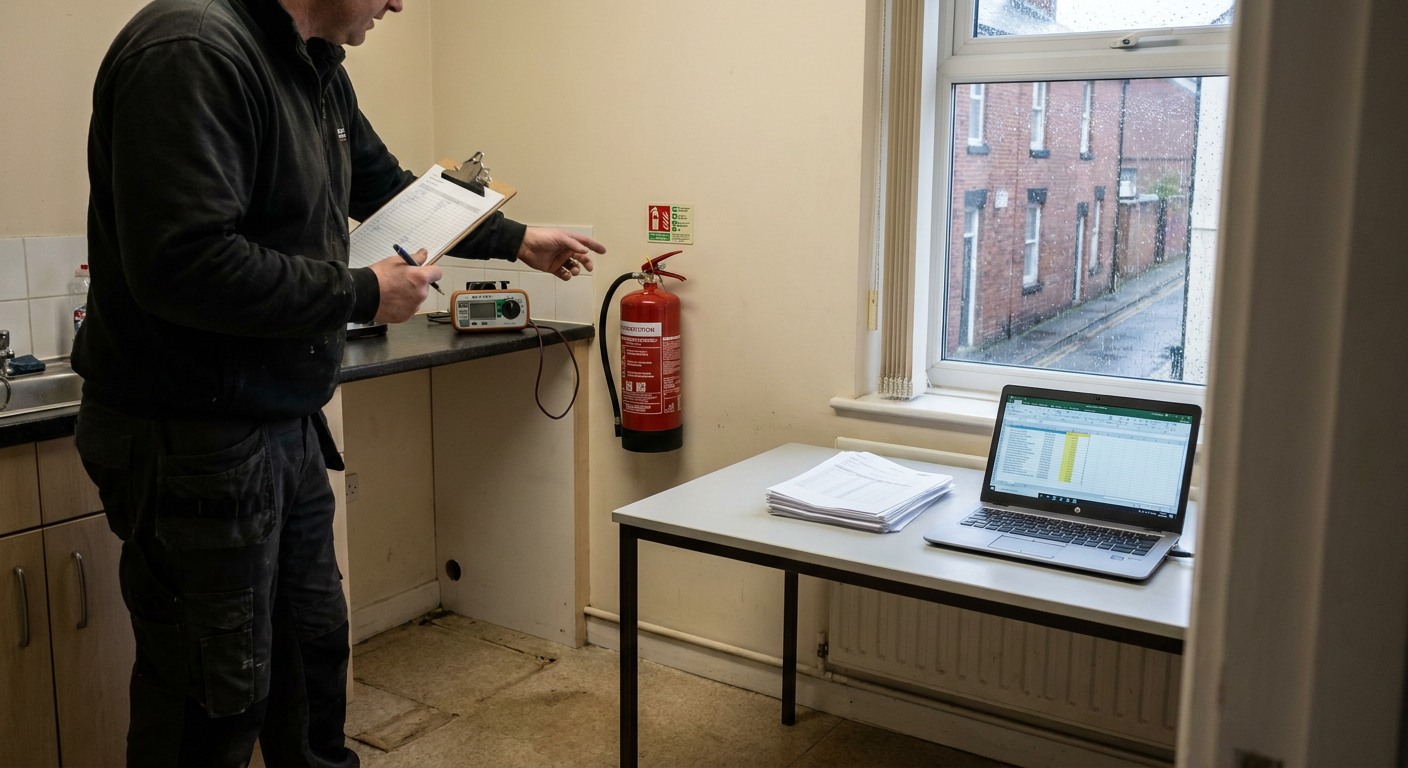
An assessor with a clipboard and extinguisher inspects a room with a laptop nearby.

Alarm system checked

Standard shared house
Grade D1 interlinked detectors reviewed
Large or converted HMO
Grade A zoned panel system inspected

Door sets examined

Standard shared house
Bedroom and kitchen doors assessed
Large or converted HMO
All doors plus stairwell enclosures checked

Escape route focus

Standard shared house
Single staircase travel distance measured
Large or converted HMO
Secondary routes and window escapes evaluated

Report detail level

Standard shared house
Core hazards and actions recorded
Large or converted HMO
Full compartmentation and strategy included

A specialist advises which scope suits after examining the home and reading the council letter.

Booking the visit and understanding costs

Landlords and agents need to know what information to provide upfront and how scheduling works in Bexley.

Information required

Direct landlord enquiry
Floor count, tenant numbers, council letter
Letting agent instruction
Management agreements and scope of work

Scheduling factors

Direct landlord enquiry
Tenant availability for room access
Letting agent instruction
Agent coordination across multiple viewings

Report delivery

Direct landlord enquiry
Sent to the property owner directly
Letting agent instruction
Copied to the managing office on request

Follow-up support

Direct landlord enquiry
Guidance on completing recommended work
Letting agent instruction
Ongoing review dates managed centrally

A specialist confirms timing and scope once the building details and council requirements are known.

Send your HMO fire safety enquiry

Describe the home and attach the council letter if you have one. The details go to a local specialist who handles HMO assessments in Bexley. Sending an enquiry does not commit you to booking.

  • No obligation to proceed
  • Local Bexley specialists
  • Fast response to enquiries

These details are passed to a specialist, as the privacy page describes.

Sending this costs you nothing. The privacy notice goes into what happens to your details. They reach one independent fire safety specialist covering Bexley, and that specialist may pay us when the enquiry is passed on. Comparing quotations with other firms remains entirely up to you.

Prefer email? Write to hello@bexleyfire.co.uk