Guide
Personal emergency evacuation plans: who needs a PEEP
Find out what a personal emergency evacuation plan is, who requires one in a Bexley building, and what details the document records so someone can leave safely during a fire.

What a personal emergency evacuation plan does
A standard evacuation plan assumes everyone in a building can hear an alarm, find an exit and walk down stairs without help. That assumption fails when someone cannot move quickly, cannot see where to go or cannot hear the warning.
A personal emergency evacuation plan, usually called a PEEP, exists because of that gap. It is a written record of exactly how one named person will get out of a building if a fire breaks out. The document sets down their usual location, the route they should take, the equipment they rely on and the people responsible for helping them.
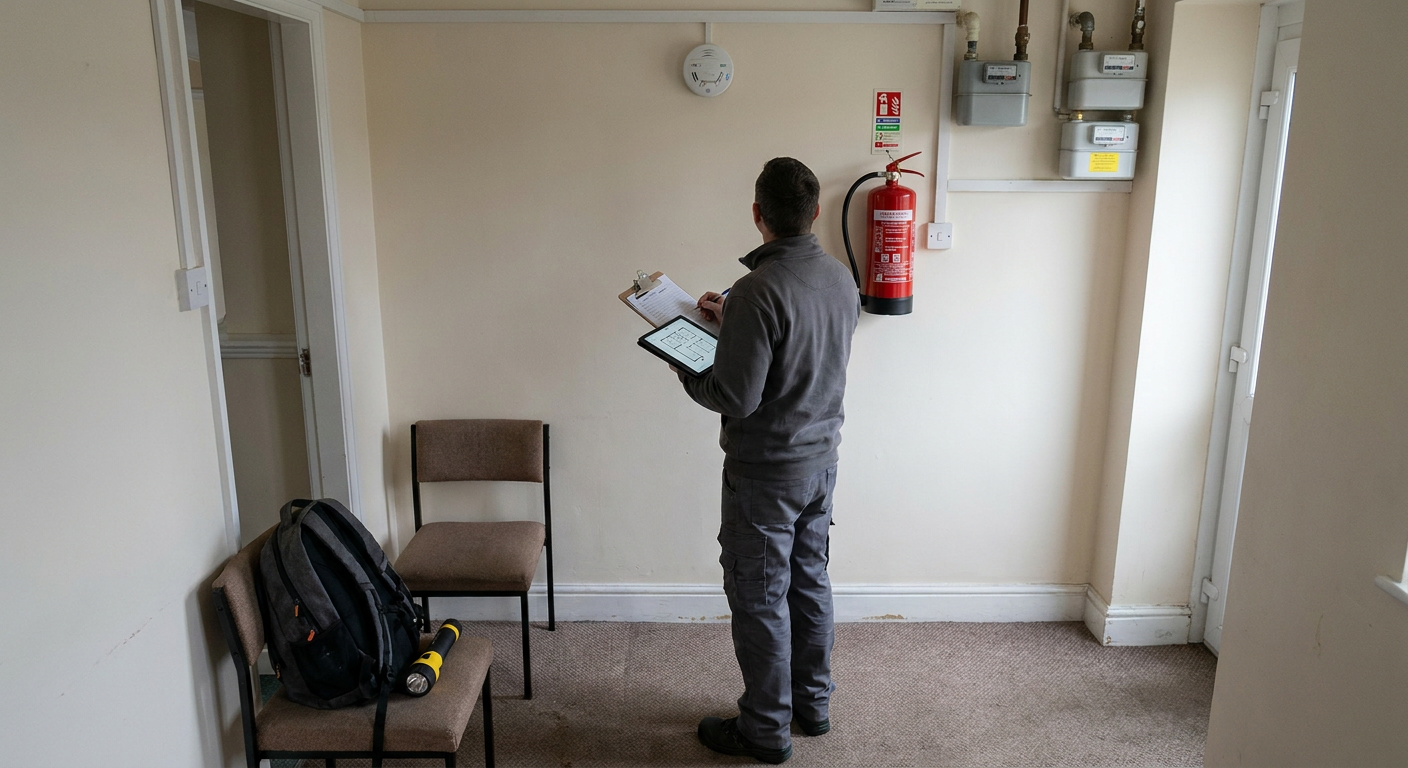
The specialist firm drafting the plan will talk directly to the person it concerns. They ask about mobility, hearing, sight and any condition that slows movement under stress. They then map those facts against the layout of the home or workplace, checking stair widths, door weights and lift policies. The result is a set of instructions specific to that individual, rather than a general notice pinned to a wall. You can read more about how these fit into wider planning on the page covering a [fire evacuation plan in Bexley](/fire-evacuation-plans).
Who needs a PEEP in a Bexley building
Anyone who cannot evacuate independently requires one. In practice that means residents or workers with limited mobility, wheelchair users, people who are blind or partially sighted, and those who are deaf or hard of hearing. Temporary conditions count too. A broken leg or late-stage pregnancy changes how fast someone moves through corridors and down stairs.
Landlords managing shared housing often discover they need several plans at once. An HMO might house a resident recovering from surgery alongside another who uses a walking frame. Each situation demands its own document. The requirements become clearer when a specialist completes an [HMO fire risk assessment in Bexley](/hmo-fire-risk-assessment), because the assessor notes every occupant whose escape would need assistance.
Blocks of flats present a different problem. Some buildings operate a stay-put policy while others require full evacuation. The chosen policy shapes what the PEEP says. If the advice is to remain inside until the fire service arrives, the plan must still account for what happens if smoke reaches the flat. Understanding the building's overall approach matters before writing anything down for an individual.
What the document records
A PEEP is not a vague promise to help. It names the person, states where they spend most of their time and describes the exact route they will follow when the alarm sounds. It records whether they need a buddy, a refuge point, an evacuation chair or a vibrating pager linked to the fire alarm system.
The plan also specifies who provides the help. In a workplace that might be a trained colleague. In a block of flats it could be a concierge or a nominated neighbour. The [responsible person](/compliance/who-is-the-responsible-person) for the building holds the legal duty to make sure these arrangements exist and work in practice.
Details matter. The document notes whether doors along the escape route are heavy enough to stop a wheelchair user, whether corridor lighting is adequate for someone with poor vision, and whether the person needs medication taken with them. Every recorded fact prevents a delay during a real emergency. A specialist reviews these points against the physical space and writes them down so there is no guesswork when the alarm goes off.
Temporary and visitor plans
Not every PEEP lasts for years. A resident who fractures an ankle needs a plan for six weeks, not forever. Temporary PEEPs cover short-term changes in ability. Once the person recovers, the document is withdrawn and the standard building procedures apply again.
Visitors complicate things further. A care worker visiting a flat daily, or a relative staying for a weekend, may have a disability the building manager knows nothing about. Buildings open to the public or receiving regular visitors use a general emergency evacuation plan for disabled visitors. This is a pre-prepared set of options staff can apply on the spot, asking a few quick questions to decide which route and which assistance method suits the person standing in front of them.
Keeping track of these variations requires discipline. The building's [fire safety log book](/news/fire-safety-log-book-for-your-building-what-to-record) should note when temporary plans start and end, so outdated instructions do not sit in a folder confusing the next review.
How a PEEP fits into fire safety management
A personal plan does not replace the building's wider precautions. It sits inside them. The [fire risk assessment](/fire-risk-assessment) identifies hazards across the whole structure. Compartmentation surveys check that walls and floors hold back smoke long enough for an assisted escape. Fire door inspections confirm that the doors along the PEEP route close properly and are not wedged open.
When all of these elements work together, the individual plan becomes realistic rather than theoretical. A route is only safe if the doors on it function and the compartments around it hold. Staff awareness training ensures the people named as helpers actually know what they agreed to do. Without that surrounding framework, a piece of paper describing an escape route offers false comfort.
The responsible person arranges the assessments and keeps the documents current. When a resident moves out or a worker leaves, their PEEP is removed. When the building layout changes, existing plans need rewriting. Maintenance is continuous, because a plan written for last year's floor arrangement may direct someone towards a blocked corridor today.
Ask about fire safety arrangements for your home
Send an enquiry about your building. The details go to a specialist firm who will respond with what they recommend, and you are not committed to booking anything by asking.
- No obligation to proceed
- Local Bexley specialists
- Plain advice first