Guide
Emergency lighting checks in communal areas of flats
Find out what emergency lighting checks involve in the stairwells and corridors of your block. Learn how a specialist firm tests the fittings, what faults to look for between visits, and what a Bexley building owner should record in the log book.
Why emergency lighting matters in shared corridors
When the mains power fails in a block of flats, the stairwell goes dark immediately. Residents trying to leave need to see every step, every change in direction, and every exit door. Emergency lighting exists to make that possible.
In Bexley, the responsible person for a residential building must ensure these escape routes remain usable during a fire or a power cut. A fire risk assessment will note whether the existing lighting is adequate for the layout of the building, but the assessment alone does not keep the batteries charged or the bulbs working. That requires regular physical checks by a specialist firm.
Corridors with no natural light are the most obvious places for emergency fittings. But they are also needed near changes in floor level, at each intersection where a resident must choose a direction, and beside every final exit door. If a fitting is missing from one of these spots, someone leaving in smoke could walk into a wall or miss the stairs entirely.
What a specialist firm looks for during a test
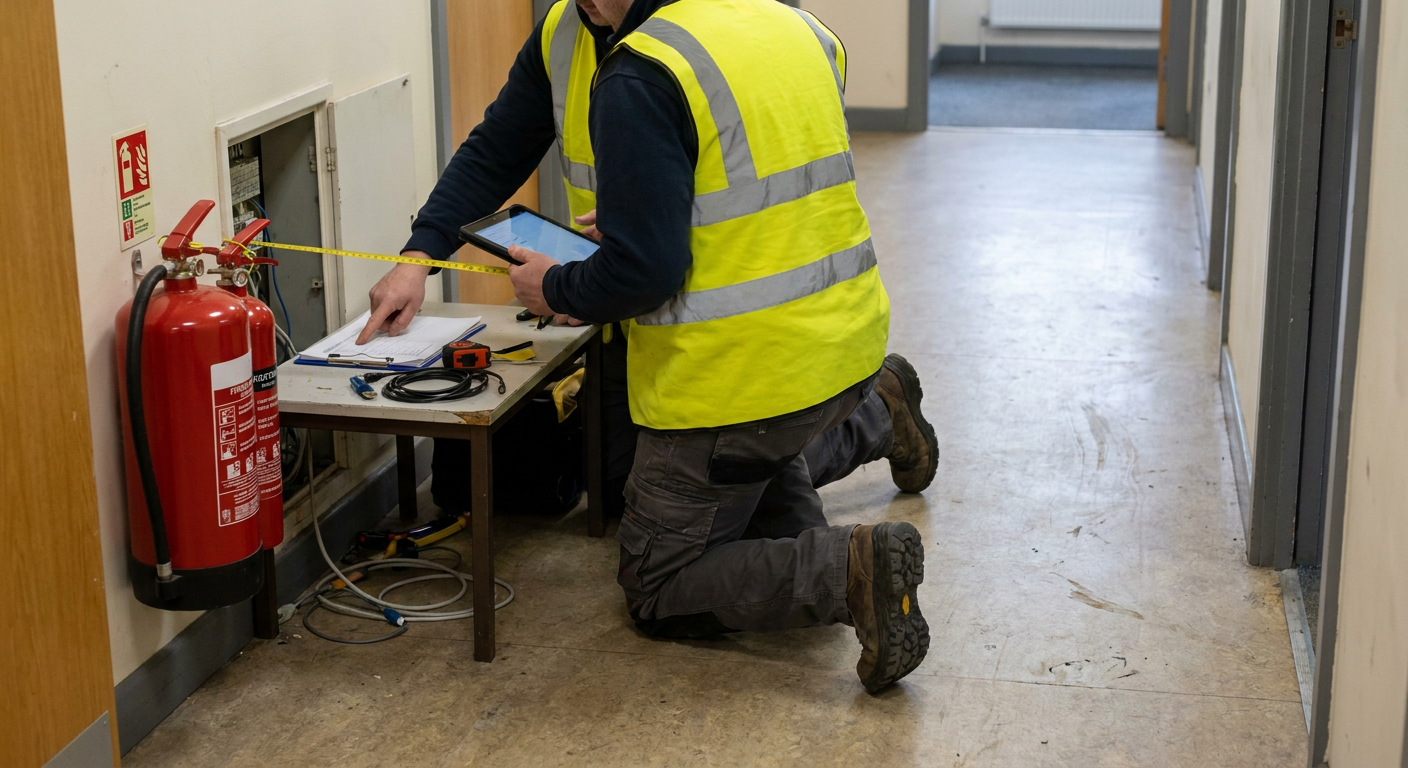
A competent contractor will simulate a mains failure to force every emergency fitting onto its battery. They then walk the entire escape route, checking that each unit illuminates fully and stays lit for the required duration, which is usually three hours in residential blocks.
During this test, the specialist firm examines the condition of each fitting. Cracked diffusers reduce the light output. Painted-over casings trap heat around the battery. Loose wiring behind a ceiling tile can cause a fitting to fail silently between inspections. The contractor notes all of these faults.
They also check the central indicator panel if the building uses a monitored system. This panel shows whether any individual fitting has dropped below its expected charge. A single red light on that board points directly to a failed unit somewhere in the building, saving the contractor from searching every corridor manually.
Once the test is complete, the contractor restores the mains supply and confirms that every fitting begins recharging. A unit that takes too long to reach full charge may have a degraded battery that needs replacing before the next scheduled visit.
Monthly flicker tests the responsible person can do
Between full discharge tests, the responsible person or a nominated individual should carry out a short monthly check. This involves switching off the mains supply to the emergency lighting circuit for a few seconds, just long enough to confirm that every fitting comes on.
You do not need to drain the batteries during a monthly check. The goal is simply to verify that nothing has failed since the last full test. Walk the stairwells and corridors while the lights are on battery power. Look for any fitting that remains dark, flickers, or glows much dimmer than the rest.
If you spot a fault, report it to the specialist firm that maintains the system. Do not wait for the next annual discharge test. A dark stairwell is an immediate hazard, particularly in a building where older residents or young children live. Recording the date and outcome of each monthly check in the building log book provides proof that the system is being monitored.
Recording results in the building log book
Every test must be written down. The log book for the building should contain the date of the test, the name of the person or firm who carried it out, the duration of the discharge, and any faults found.
If a battery was replaced or a fitting repaired, that work needs its own entry alongside the original fault. An inspector or a fire officer reviewing the records will want to see that problems were fixed, not just noted. Gaps in the log book suggest gaps in the maintenance.
For buildings in Bexley covered by the Fire Safety (England) Regulations 2022, keeping accurate records is a legal requirement rather than a recommendation. The regulations place specific duties on the responsible person in multi-occupied residential buildings, and documented evidence of equipment testing forms part of that duty.
Store the log book where the responsible person can access it quickly. If a fire occurs overnight, the attending fire service may ask to see the maintenance history for the emergency lighting before they even finish clearing the building.
Ask about emergency lighting checks for your home
Send details about your building and a specialist firm will reply to discuss what the stairwells and corridors require. There is no obligation to proceed with any work.
- No obligation to proceed
- Local Bexley specialists
- Clear written response